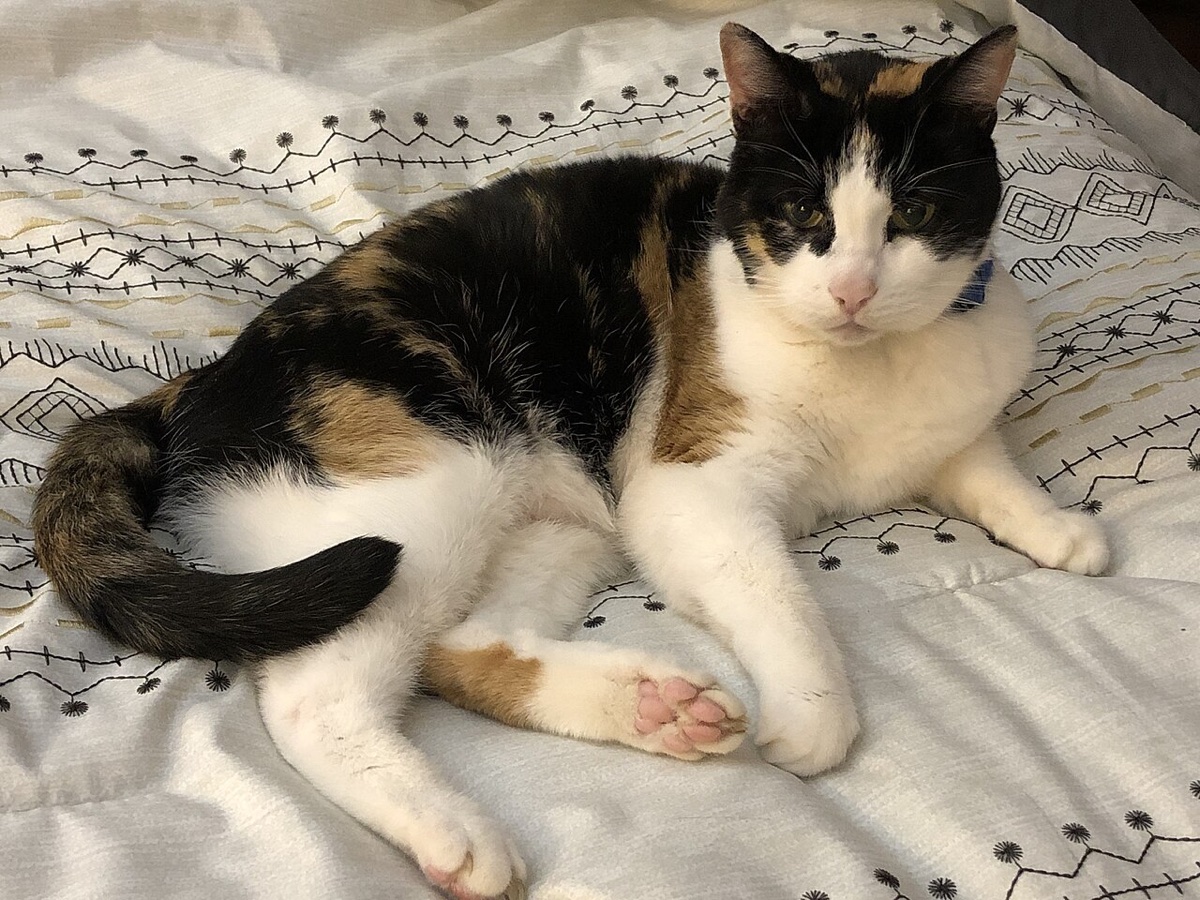
Calico · 26.5 Hz purr
Pumpkin the Calico
Slow to warm up, loves head pats
“Rest a calm palm on the top of my head first, then let me decide when to come back for more.”
- Personality
- Slow to warm up, loves head pats
- Likes to be petted
- the top of the head
- Favourite toy
- crinkle ball
- Daily food
- 36 g twice a day
Pet Pumpkin here
Glide your hand across Pumpkin to hear her purr. Try the top of the head, and avoid the belly.
Who Pumpkin is
Pumpkin is a calico, which means three colours in one coat and, in her case, three opinions. She is slow to trust and quick to forgive, and the two things happen in that order every single time you come home.
What she likes
A palm on the top of her head, and then nothing for a while. Pumpkin is a cat that prefers to be the one who initiates the second contact. Give her the first stroke and she will accept it; wait a minute and she will ask for the next one.
Calicos are almost all female: the black and orange patches sit on the two X chromosomes, so a cat with both needs two X's. That is also why calicos cannot really be bred true, and why no two are quite the same.
Her routine
Pumpkin eats about 36 grams a day, and she is one of the two cats in the cast most likely to walk away from a full bowl. Her toy is a crinkle ball, batted rather than chased, and she will play with it alone for ten minutes before noticing you.
If you feed a real calico like this, watch the water more than the food. Cats that graze drink less in one go, and a fountain or wet food is the simplest fix.
Questions
Are all calicos female?
Almost all. The black and orange patches are carried on the X chromosome, so a calico needs two X chromosomes. Male calicos exist but are rare and usually infertile.
Why is Pumpkin slow to trust?
That is her written temperament: she accepts the first stroke on the top of her head, then wants to initiate the rest herself. Rushing her costs affection in the game.
Do calicos have a personality type?
No scientific one. The widely repeated claim that calicos are feisty comes from owner surveys, not from anything in the genetics.